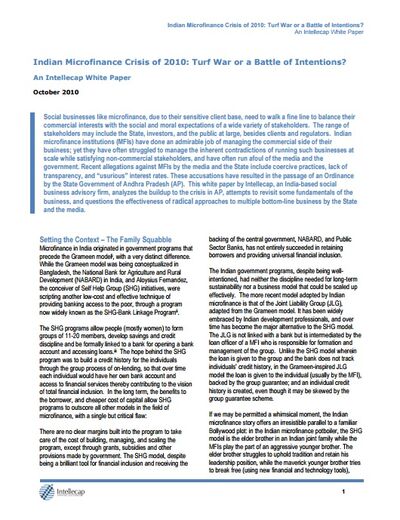
Indian Microfinance Crisis of 2010: Turf War or a Battle of Intentions?
October 26, 2010
This research was published more than 5 years ago, some information may be out of date.
This white paper from Intellecap offers balanced perspectives on microfinance in India. This paper provides a starting point for conversation by detailing a nuanced view of the microfinance industry beginning with a history rooted in policy to a ban in Andhra Pradesh in October 2010.
From the paper's introduction:
Social businesses like microfinance, due to their sensitive client base, need to walk a fine line to balance their commercial interests with the social and moral expectations of a wide variety of stakeholders. The range of stakeholders may include the State, investors, and the public at large, besides clients and regulators. Indian microfinance institutions (MFIs) have done an admirable job of managing the commercial side of their business; yet they have often struggled to manage the inherent contradictions of running such businesses at scale while satisfying non-commercial stakeholders, and have often run afoul of the media and the government. Recent allegations against MFIs by the media and the State include coercive practices, lack of transparency, and "usurious" interest rates. These accusations have resulted in the passage of an Ordinance by the State Government of Andhra Pradesh (AP). This white paper by Intellecap, an India-based social business advisory firm, analyzes the buildup to the crisis in AP, attempts to revisit some fundamentals of the business, and questions the effectiveness of radical approaches to multiple bottom-line business by the State and the media.