
What is impact measurement and management?
Impact measurement and management (IMM) is integral to making effective impact investments. It includes identifying and considering the positive and negative effects one’s investment approaches have on people and the planet, and then figuring out ways to mitigate the negative and maximize the positive in alignment with one’s goals.
How should investors approach IMM?
Investors’ approaches to impact measurement and management will vary based on their objectives and capacities. Measurement and management choices reflect investors’ goals and intentions. In general, best practices for impact investing include:
- Developing a theory of change to identify the path to reach social and environmental impact objectives
- Collaborating with relevant stakeholders to develop the theory of change and impact objectives
- Managing strategic impact on a portfolio basis, not just individual investments
- Setting performance targets related to these objectives using standardized metrics
- Monitoring and managing the performance of investments against these targets, including negative and unexpected impacts
- Reporting on social and environmental performance to relevant stakeholders
- Optimizing future impact returns based on data and learnings from past investments
What are the challenges facing impact investors in their approaches to IMM?
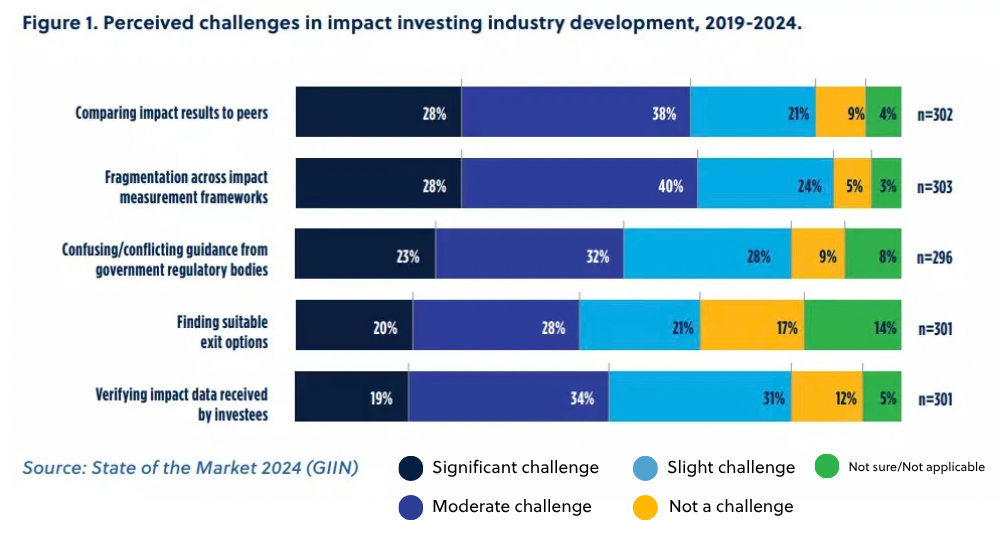
The main issue facing investors in their approach to impact measurement and management (IMM) is fragmentation: investors are using an increasingly diverse range of frameworks and metrics. This may be influenced by evolving regulatory environments, varying approaches to harmonizing impact aims with investment theses and reponses to ongoing market fluctuations.
Another major problem, not just for individual investors but for the industry at large, is impact washing, where the social/environmental impacts of an investment practice or vehicle are greatly exaggerated or outright fabricated. This can often result from normal investment practices being re-labeled as "impact" in order to better market them or for a firm to benefit from exisiting tax incentives. Impact-washing is a growing concern that threatens the integrity, credibility and long-term growth of the impact market. Through a collective effort to promote transparency, rigor and accountability in IMM, the GIIN and our industry partners can better secure our industry and planet for future growth.
According to our State of the Market 2024 report, there are encouraging developments in the growth and proliferation of align IMM practices:
- More than two-thirds of investors are incorporating impact criteria into their investment governance documents.
- Investors are increasingly using third-party verification of their impact management processes.
- These shifts suggest greater formalization, accountability, and sophistication in how impact is measured and managed.
Despite the proliferation of data collection and analytical tools, impact investors often feel hindered in understanding their impact performance.
According to the GIIN’s 2024 State of the Market report, impact investors perceive the most significant challenges facing the industry today to be: fragmentation across myriad impact measurement frameworks (92% of respondents found this challenging); difficulties comparing impact results to peers (87%); and confusing regulatory guidance (83%). Check out a breakdown from our Annual Impact Investor Survey below:
Today, impact investors largely agree that impact must be measured, but the question that remains is how to do it in a way that is transparent, decision-useful and enables comparability. Such information would enable investors to manage toward outcomes, not just for intentions.
What is the GIIN doing to uplift IMM adoption and harmonization?
As a home to two of the most widely-adopted, voluntary industry standards and frameworks for IMM – IRIS+ and the Operating Principles for Impact Management (OPIM or Impact Principles) – the GIIN's IMM initiatives help provide common frameworks and metrics guiding investors investors to understand best practices and advance the market infrastructure critical to increasing the scale and effectiveness of the industry. In addition to IRIS+ and OPIM, the GIIN provides research, training and other targeted programming to enhance IMM practices of investors and the broader field.
-
IRIS+
IRIS+ is a set of tools and guidance for impact investors to measure, manage and optimize their impact. Developed by the GIIN, IRIS+ is a free, public good that helps investors make more informed decisions and deliver stronger outcomes for people and the planet.
Key features of IRIS+:
Thematic Taxonomy: a classification system developed to help impact investors systematically drive positive outcomes for people and planet.
Core Metric Sets: standardized short lists of metrics and curated indicators developed to help investors understand, pursue and measure specific outcomes.
Catalog of Metrics: a repository of qualitative and quantitative performance metrics used by leading impact investors to measure and manage the social and environmental impact of their investments.
Mapping the UN Sustainable Development Goals (SDGs), including both SDG goals and targets
Alignment to other major frameworks and standards, including the five dimensions of impact, and alignment to varying degrees to more than 50 metrics frameworks, standards and platforms
-
OPIM
The Operating Principles for Impact Management (the Impact Principles or OPIM) are a global voluntary standard for integrating impact throughout the investment lifecycle. The Impact Principles bring clarity to the impact investing market on what it means to be an impact investor in practice, thereby improving investor confidence and integrity while also addressing concerns related to impact-washing and elevating best practices.
As a principles-based framework, the Impact Principles can be flexibly adapted to apply across asset classes, impact themes and to all types and sizes of investors.
For asset managers, the Impact Principles provide a common framework for IMM best practices throughout the investment lifecycle from strategy to exit.
For asset owners and allocators, the Impact Principles provide a reference point for assessing the impact management systems of funds and institutions, engaging with asset managers, and signaling their expectations for robust IMM.
For the broader field, the use of the Impact Principles by investors help grow and strengthen the market with transparency, discipline and credibility in impact practice and address concerns regarding impact washing.
By choosing to become a Signatory, investors of all types can demonstrate their commitment to impact rigor and transparency – publicly disclosing their alignment with the Impact Principles and providing a regular independent verification of the alignment. They also contribute to critical market infrastructure for scaling impact investing with integrity.
Other GIIN resources
-
GIIN Training
The GIIN regularly hosts training sessions for impact investors across the industry, from entry-level analysts to chief impact and investment officers, in order to educate practioners on the latest trends and approaches to IMM. Visit our training website to learn more and register for upcoming classes.
-
Impact Target Setter and Quantifier Tools
Developed by the GIIN's Impact Lab, these software tools are designed to help asset allocators make more informed, comparable and context-driven decisions when selecting funds, setting impact targets and evaluating outcomes across diverse investments. Learn more and use the tools today.
-
Data, Direction and Decisions: What we know about measuring and managing impact performance
Drawing from over 100 impact investors, researchers, service providers and standard setters, this report offers practical recommendations to move the field forward. By addressing these questions head-on, impact investing actors can improve clarity and transparency, improve decision-making and increase the rigor and credibility of the field.
-
State of the Market 2025
As the field-builder for impact investing, the GIIN conducts and publishes research as a free public good, providing insights that investors need to navigate an ever-changing market. The GIIN’s latest market intelligence, the State of the Market 2025: Trends, Performance and Allocations, is powered by our Annual Impact Investor Survey and dives deep into how investors are using IMM to inform their investment strategies, what challenges they still need to tackle and where the future of IMM is taking us.