
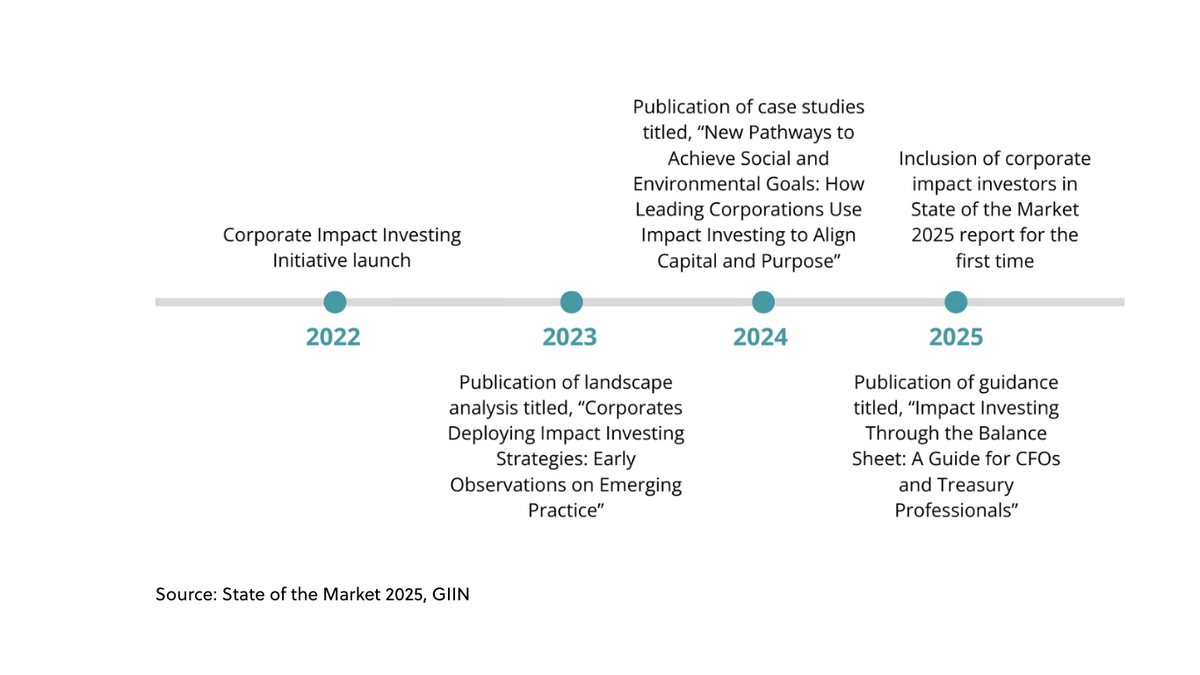
It’s been three years since the Global Impact Investing Network (GIIN) launched the Corporate Impact Investing Initiative to explore how corporations invest their own capital and engage with the impact investing industry in service of their organization’s social and environmental goals. With generous support from PayPal, TELUS Pollinator Fund for Good, Visa Foundation, Deloitte and the Walton Family Foundation, this initiative has been the cornerstone of the GIIN’s strategy to mobilize impact capital from companies around the world. In this article, we will share an update regarding our progress to date, and unpack the trends, activities and allocations from corporate impact investors in the State of the Market 2025 report.
But first, what is the Corporate Impact Investing Initiative?
Launched in 2022, the initiative provides corporations with strategies and frameworks for executing impact investments and collaborating with impact investors. Through publications and programming, the initiative creates a deeper understanding of the areas where impact investing can be effective and socializes how the world’s largest corporations could use impact investing to achieve their social and environmental goals.
To accomplish these goals, a series of questions needed to be answered regarding what, how, where and why companies choose to pursue impact investing. Additionally, it was critical to learn about the benefits experienced by those companies engaging with impact investing and barriers for those who chose not to. To understand these points, the GIIN spoke with more than 100 corporate representatives from across the globe.
Many of the insights gathered through these interactions have been distilled into case studies of companies across sectors that examined how organizations weave impact investing into their strategies or partner with others to scale their goals. These were complemented by a position paper that offered a broad look at the corporate impact investing landscape. In 2025, the GIIN published guidance to help CFOs identify new ways to work with their corporate treasury function to contribute to the organization’s sustainability strategy through cash management activities.
These publications helped establish a solid knowledge base and gain a clear perspective on the choices that companies make to develop and execute their impact investments to ensure they can deliver value to their sustainability and business goals.
The knowledge gathered by the GIIN allowed practitioners, academics and the market to understand the how (the mechanics), but not how many (the details). To complete the picture, the GIIN used its annual impact investor survey to ground in data the discussions about corporate entities engaging with impact investing.
For the first time, the 2024 survey included tailored questions for corporations and the findings were published in our latest market intelligence, the State of the Market 2025. This effort begins to build the foundation of understanding how corporations engage with impact investing, what motivates their choices and how their activities evolve over time. What follows are some of the first signals from this work.
Understanding corporate impact investment portfolios
The initial data collection effort is a modest starting point as the total sample consists of 12 companies. A majority of respondents were corporate entities (58%), with the rest being corporate foundations (42%). Respondents came from the following sectors: healthcare (33%), information technology (25%), industrials (17%), consumer discretionary (8%), energy (8%) and financials (8%). Respondents self-reported data from 2024 and the GIIN published the report in October 2025.
Most respondents concentrated their impact investing activities in a single business function (67%), while others spread them across multiple departments. The most commonly used functions were sustainability, an impact venture capital arm and a corporate foundation. This diversity underscores that there is no single-entry point for corporations.
Geographically, most of the sample were headquartered in Europe (58%), followed by the U.S. (33%) and Southeast Asia (8%). Their impact assets under management (AUM) varied widely, from a few million dollars to over $2 billion USD, with a median of $50 million USD. The earliest corporate impact investments in the sample dated back to 2009, while the most recent began in 2024.
Eighty-three percent of respondents deployed capital in 2024, with half deploying capital from the corporate balance sheet. On average, respondents deployed $15.2 million of impact capital in 2024. The maximum value was $100 million and the minimum value was $2.1 million. The total AUM deployed in 2024 was $182.4 million.
When it comes to how assets are allocated, corporations leaned heavily on direct investments, which accounted for 62% of their impact AUM on average. The rest was placed through indirect vehicles (38%), though most investors in the sample used a mixed approach. By asset class, private equity dominated portfolios, followed by private debt, with several respondents allocating a portion to equity-like debt instruments.
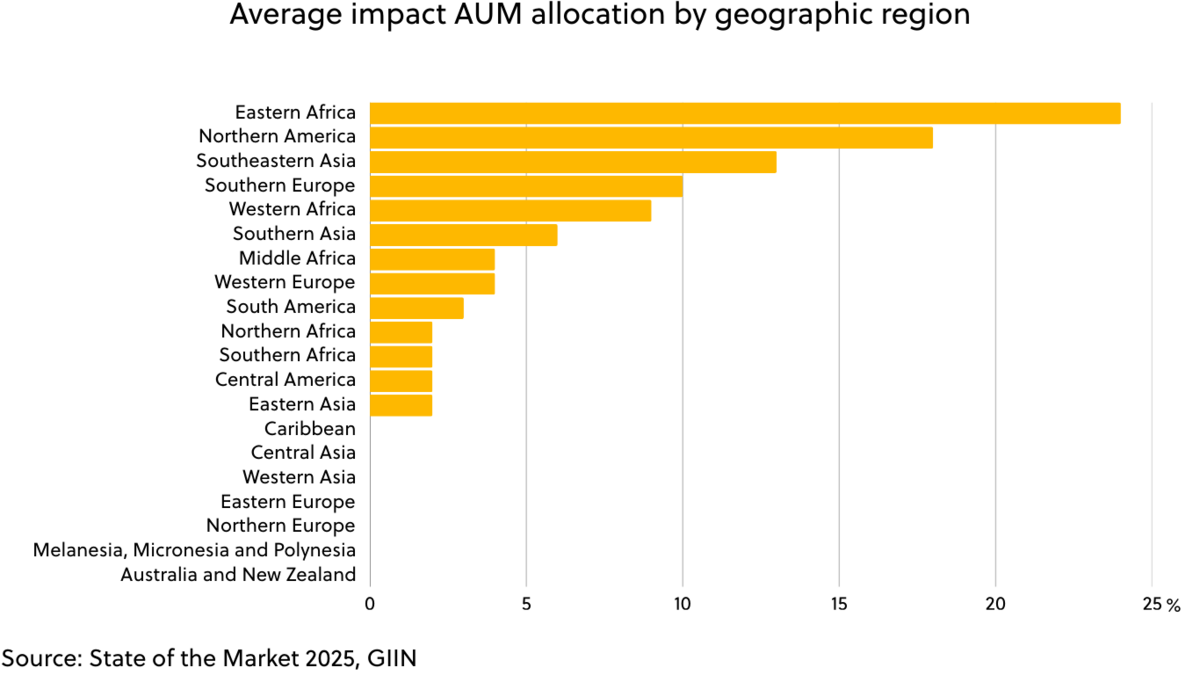
The appetite for early-stage activity was strong: three-quarters of respondents invested in seed and startup stages, and the same proportion invested in the venture stage. Half of respondents reported investing in growth-stage businesses. East Africa and North America were the regions with the highest average impact AUM allocation.
Healthcare and agriculture emerged as areas where half of corporate respondents allocated capital. Those that invest in healthcare allocated, on average, more than 70% of their impact AUM to this sector – aligning with 33% of respondents operating within the healthcare sector. Forty-two percent of respondents also invested in energy and transportation, and 33% in financial services (including microfinance). Moreover, the focus on underserved populations was a consistent theme throughout. Eighty-three percent of respondents targeted low-income individuals, dedicating the majority (80%) of their assets toward this group.
In 2024, 75% of corporate respondents did not participate in any blended finance deals. Among those who did, all were motivated by the opportunity to provide catalytic capital aimed at de-risking transactions for other funders or offering loss protection, among other motivations.
Getting to know corporate impact investors’ priorities and profiles
Corporate entity and corporate foundation respondents in this sample allocated their total impact AUM almost equally between market-rate return strategies and capital preservation, each representing 38-39%. This balance reflects the dual imperative corporations face: to steward shareholder value while demonstrating authentic social and environmental contributions. The remaining 22% is allocated to in-between opportunities that fit a close-to-market rate profile.
Return profile was one of the biggest differences when comparing impact investors against corporations. The results from the State of the Market 2025 show that for impact investors at-large, 89% of impact AUM was invested targeting market-rate returns, 9% targeting below-market but near-market returns, and just 2% towards below-market investments targeting capital preservation. Corporate entities and corporate foundations have a unique return profile even when comparing them to family offices and foundations.
When asked about what matters most in evaluating an investment, corporations prioritized philosophy alignment and impact performance. Financial performance ranked behind these, with regulatory adherence and board expectations further down the list. Exit strategy and time horizon were generally considered least important. This order of priorities highlights that corporations are not solely chasing returns with their impact investing. There is a strong emphasis on the impact returns and alignment with related objectives.
Satisfaction levels also reflect this orientation. Respondents reported being somewhat satisfied with both financial and impact performance, but more were very satisfied with their impact results than with their financial ones. Reasons cited included alignment with mission, contribution to change, positive stakeholder feedback and progress relative to targets. Half of the respondents rated their impact performance higher than that of their peers.
Certainly, corporate entities are not immune to macro forces. Economic downturns, inflation and rising interest rates were cited as the biggest factors shaping investment activity in 2024. Yet despite these headwinds, most respondents described the state of the impact investing market as one of growth, with more coordination, more centers of activity and stronger performance infrastructure. When asked about what actions could advance the market, corporations gravitated toward practical enablers: aligning incentives with impact results, sharing best practices for measurement and reporting, advancing blended finance vehicles and establishing tax incentives.
Anticipated activities and allocations from corporate impact investors in 2025
Looking ahead, respondents signaled an increase in activity. Corporate investors plan to deploy nearly double the capital in 2025 compared with 2024, rising from $182.4 million last year to over $365.3 million this year. The median planned impact capital to deploy in 2025 is $7 million, with a wide spread between smaller allocations and a quarter-billion-dollar commitment at the top. On average, respondents expect to make about seven investments each, with a total of 88 expected transactions across the sample.
Geography tells an interesting story. Corporations plan to expand allocations most significantly in West Africa, South Africa and South America over the next five years. This suggests that corporations see opportunity in emerging markets where capital can achieve strong impact and complement their global strategies. Respondents did not indicate significant decreases in allocations across any region.
Only one respondent will increase their allocations across a wide range of sectors, with a majority of respondents maintaining focus on their current allocations. However, 25% of respondents will increase their investments in healthcare over the next five years.
Keeping a pulse on corporate impact investing through the GIIN’s annual impact investor survey
This first year of including specific questions for corporate impact investors in the GIIN’s annual survey is a critical milestone in our Corporate Impact Investing Initiative strategy. This data allows us to see baseline patterns in how corporations invest to deliver their social and environmental goals: their functions, allocations, priorities and expectations.
This data also points to a community of leaders that is steadily increasing its activity, aiming to balance financial and social outcomes and demonstrating readiness to engage in new geographies and sectors. Just as important, corporations are clear about why they are doing this: to align with mission and values, to support underserved communities and to deliver on their sustainability goals.
By establishing a consistent pathway for corporate entities in the survey, the GIIN can now better track corporations' attitudes and behaviors over time, as well as assess how they can work more effectively with the broader impact investment industry to drive meaningful progress for people and the planet.
Finally, the GIIN will use this data to inform new and existing activities within the Corporate Impact Investing Initiative that bring companies and impact investors together across different topics, such as healthcare and agriculture, to explore complementarities to their impact investing approaches and identify practical solutions to systemic social and environmental challenges.
To learn more or get involved in the Corporate Impact Investing Initiative or GIIN membership, you can contact [email protected].
If you’re an organization making impact investments, take the 2026 Impact Investor Survey and support the impact investing industry for years to come.