Introduction to Nest and Schroders Capital
Understanding why climate solutions investing is a shared priority for both organizations
-
Nest
Nest began its climate journey in 2020 with the goal of aligning its portfolio with the Paris Agreement and achieving carbon neutrality by 2050. Its climate policy rests on four levers: asset allocation, manager selection, stewardship and policy advocacy.
Initially focused on transition risk, Nest recognized the need to invest in opportunities created by climate action, particularly renewable energy, thematic equities and nature-based solutions. Nest’s first climate solutions objective set in 2021 was to invest at least £1.4bn in renewable infrastructure through our infrastructure equity and debt funds and is on track to achieving this goal early, with £1.34bn invested at the end of March 2025.
By 2024, Nest’s strategy evolved to increase focus on a just transition, physical risks and the climate-nature nexus. As technological developments accelerate, Nest identified climate solutions as a core pillar of its approach. The fund believes supporting climate solutions is essential to delivering long-term value for members while addressing systemic climate challenges. It has also begun assessing whether the scale of its investments is sufficient to meet its long-term climate objectives. -

Schroders Capital
Schroders launched its climate strategy in 2007 with its Global Climate Change Equity Strategy. Today, the approach spans public and private markets and is anchored in four pillars: insights, influence, innovation and inspire.
Schroders Capital , the private assets arm of Schroders, aligns with the firm’s overall climate strategy while applying asset-class-specific tools and levers. For example, its private equity strategy focuses on asset-light business models in healthcare, technology, business services, industrials and consumer sectors. The firm invests in lower- and mid-market buyouts, as well as venture and growth opportunities across Europe, the U.S., India and China.
Many portfolio companies have relatively low carbon footprints but may still offer climate solutions. In venture portfolios, this includes backing new technologies that support climate mitigation and adaptation. In buyouts, Schroders Capital invests in some service providers and enablers of climate solutions, such as companies servicing renewable power grids, producing and installing solar panel infrastructure, operating waste management or recycling platforms, and running secondhand marketplaces and other circular economy businesses.
As of December 2025, Schroders manages more than £15.8 billion in dedicated climate strategies across public and private markets. Its internal Climate Product Framework classifies strategies as lower carbon, climate action and/or climate solutions to clarify the type of climate outcome each strategy supports.
Nest and Schroders Capital collaboration
In 2022, Nest appointed Schroders Capital to manage a private equity portfolio focused on established and emerging businesses at the forefront of innovation, including in healthcare, technology, financial services and consumer sectors, as well as growth areas such as artificial intelligence. These businesses operate across North America, Asia and Europe, including the UK.
To date, Nest has committed £1.5 billion to the strategy.
How both Nest and Schroders are mobilizing capital more effectively across asset classes
-
Nest
Nest views climate solutions as a cross-portfolio priority rather than a thematic silo. The fund deploys capital through:
• Dedicated mandates in renewables, timberland and thematic equities
• Mainstream integration by working with managers to identify climate solutions within diversified mandates
This approach enables Nest to capture opportunities across asset classes and build consistency in how climate solutions are defined and evaluated. Private equity was identified as a priority asset class for establishing the potential for climate solutions. Through engagement with Schroders Capital, Nest is establishing a baseline of current exposure to guide future capital allocation. -
Schroders Capital
Schroders has spent over a decade building a multi-dimensional approach that connects firmwide strategy to specific investment disciplines and cross-asset capabilities. Across strategies, the firm works to improve consistency in identifying, assessing and reporting climate solutions.
Proprietary tools and data enable alignment across asset classes and support investment decisions grounded in credible evidence of contribution to climate goals. By connecting data, methodologies and decision-making across asset classes, the firm creates a more integrated view of how portfolios contribute to real economy decarbonization.
In private markets, Schroders Capital channels capital through platforms such as Schroders Greencoat to finance renewable energy infrastructure. Its private equity and venture strategies target growth-stage and lower mid-market buy-out companies advancing decarbonization and resource efficiency. Climate considerations are also embedded across real assets, including investments in the built environment, sustainable transport and energy efficiency.
Using the GIIN Climate Solutions Investing Framework
Nest: Structuring conversations and establishing a baseline
For Nest, the GIIN Climate Solutions Investing Framework offers a practical and flexible way to translate high-level climate ambition into actionable steps. Because Nest invests through external managers, the framework helps structure and standardize those conversations.
Using the framework, Nest shifted manager discussions from “Do we invest in climate solutions?” to “Where are climate solutions within the portfolio, and how can we better measure and expand them?”
The framework guided Nest in clarifying mandate intentions, whether the climate outcomes were explicit or incidental, and in assessing contribution, including avoided emissions potential. Nest instructed Schroders Capital to use its climate solutions identification tool to assess Nest’s private equity portfolio. The assessment produced an estimated percentage of climate solutions exposure and alignment across categories.
The framework also encouraged Nest to consider prioritization, identifying where additional capital could have the greatest effect across sectors and asset classes. This helped distinguish between areas of the portfolio already contributing to decarbonization and those with the potential to deliver greater climate benefit with targeted investment.
Schroders Capital: Strengthening methodology and client dialogue
Schroders Capital approached the GIIN’s Climate Solutions Investing Framework as validation of its internal methodology and a reference tool for client engagement. While its tools operate at the individual investment level, the framework focuses on strategy-level analysis. Comparing the two helped confirm areas of alignment and identify where portfolio-level communication could be strengthened, particularly around climate thesis, contribution, prioritization and managing uncertainty.
The framework provides a common language for communicating results and for articulating the climate thesis underpinning investment strategies. For example, Schroders Capital used the contribution criterion to demonstrate how investments across asset classes deliver measurable climate benefits and the uncertainty criterion to explain assumptions behind avoided emissions estimates. In doing so, Schroders Capital demonstrated that its approach to identifying and quantifying climate solutions can withstand external scrutiny and support consistent dialogue with asset owners. The firm goes beyond the framework’s minimum guidance by applying its tools not only to climate-focused thematic strategies but across broader portfolios.
Over the past year, Nest and Schroders Capital’s private equity team have worked together to assess climate solutions exposure of their private equity portfolio. As Nest sought to understand its existing exposure to climate solutions beyond clearly defined thematic strategies, it was important that Schroders Capital demonstrate a clear methodology for assessing exposure, highlighting its contribution and disclosing the assumptions and uncertainties underpinning its analysis. More information on this exercise between Nest and Schroders Capital can be found here: Broadening horizons: Uncovering the role of climate solutions in non-thematic portfolios. A worked example between Schroders Capital Private Equity and Nest.
By embedding the framework into client interactions, Schroders Capital strengthened the connection between portfolio-level analysis and real-world climate outcomes. The process clarified how avoided-emissions analysis and qualitative assessments of contribution link to broader decarbonization goals and where assumptions or uncertainties remain. The GIIN Climate Solutions Investing Framework also supported the private equity practices in explaining what clients should also be looking for in a mainstream, lower-mid market buyout investment portfolio, strengthening the credibility of its narrative with clients.
Applying the GIIN Climate Solutions Investing Framework and considering their strategies through the lens of sufficiency, both Nest and Schroders Capital gained practical insights into how climate solutions can be identified and scaled across portfolios.
For Nest, the process highlighted the importance of consistent definitions and data collection across asset classes. It also underscored how structured engagement with managers can reveal climate solutions already present within portfolios. For Schroders Capital, the exercise reinforced the value of translating complex methodologies into clear, client-facing narratives that show how investments contribute to climate outcomes in measurable ways.
Both organizations have found that the framework’s flexibility has allowed them to apply its principles differently while maintaining a shared understanding of ambition and contribution.
Zooming in on two of Nest’s private equity portfolio companies
Source: Schroders Capital, 2026.
The GIIN’s framework helped Nest understand how their existing allocations through Schroders Capital look when the framework is applied. From there, Nest and Schroders Capital agreed to apply Schroders Capital’s screening process to two of Nest’s private equity portfolio companies: NG Nordic and Contenur.
These companies were selected to illustrate two key points. First, that climate solutions extend beyond traditional mitigation or adaptation technologies and include circular economy business models; and second, that a value-chain perspective is essential. Even when individual companies may appear less directly influential in delivering climate outcomes, the effectiveness of the value chain depends on the contribution of all participants. In short, climate solutions enablers play an important role in transitioning to a low carbon economy.
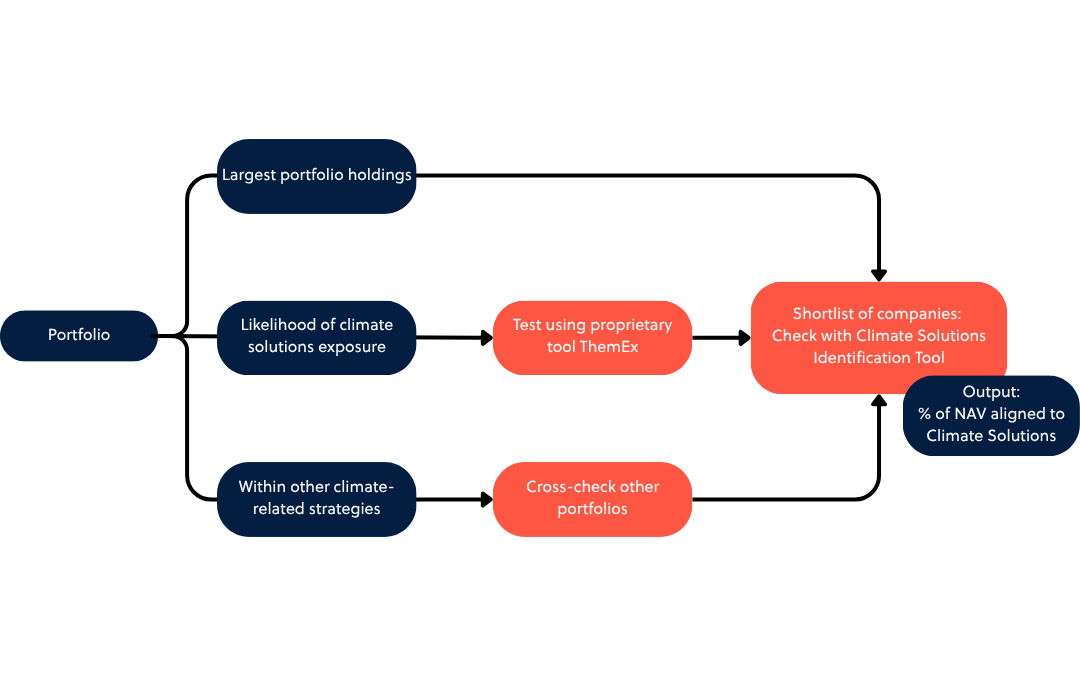
As a first step, the portfolio was screened against existing dedicated climate investment strategies managed by Schroders Capital. Industry classification was then used as a screening tool, particularly to assess the likelihood of climate, nature or circular economy exposure, as defined by Schroders’ proprietary public markets tool, ThemEx.
The companies identified through this initial screening were assessed using a proprietary climate solutions identification tool from Schroders. The tool compares industry classifications and taxonomies to estimate a percentage range of portfolio net asset value (NAV) exposure to climate solutions, weighted by each company’s revenue contribution. The lower end of the range addresses direct climate solutions exposure, while the upper end includes related activities like waste management from a circular economy perspective.
NG Nordic presents a clear alignment case as a leader in waste treatment with a cradle-to-cradle focus. Contenur initially seems to be a less obvious climate solutions enabler but nonetheless contributes to GHG emissions reductions by improving the efficiency and effectiveness of waste storage and pickup in urban areas.
| Company name | NG Nordic | |
| General Partner | Summa Equity | Nexxus Iberia |
| Business Model Description | NG Nordic provides a broad range of circular and environmental services. Through waste treatment, recycling, depollution of hazardous materials, construction reuse and sustainable demolition, NG Nordic expands access to circular raw materials and helps decarbonize society by transforming waste into valuable resources and removing hazardous substances from circulation. | Contenur designs, manufactures and maintains containers for urban waste management. The company operates in both developed and emerging markets and plays a role in improving waste collection systems. |
| Initial screening |
|
|
| Schroders Capital Climate Solutions Identification Tool findings |
|
|
Source: Schroders Capital; Nest; Summa Equity; NG Nordic; Nexxus Iberia; Contenur, 2026.
Looking ahead
Nest and Schroders Capital view their engagement with the GIIN Climate Solutions Investing Framework as the beginning of a longer-term process rather than a one-time exercise. Both organizations are focused on embedding what they learned into decision-making and partner dialogue.
For Nest, the next phase includes updating its baseline assessment of climate solutions exposure and strengthening consistency across asset classes. The fund plans to deepen engagement with external managers to ensure that climate-related objectives and data requirements are understood and reflected in mandate design. Nest also intends to refine how it measures progress over time, considering not only whether investments qualify as climate solutions but how their contribution to decarbonization and adaptation evolves as markets mature.
For Schroders Capital, the priority is to continue refining the tools and methodologies underpinning its climate solutions analysis. The firm is expanding its own decarbonization framework to address both mitigation and adaptation and developing new ways to quantify outcomes with greater transparency and comparability. A key priority for the private equity division is to continue refining methodologies to measure the impact of climate solutions enablers. This goes hand-in-hand with continued awareness raising with investors and investees of the financial and societal importance of investing in lower mid-market climate solutions enablers.
Both organizations acknowledge that this work will continue to evolve as the market matures and data quality improves. Their focus remains on applying the framework to strengthen internal alignment, enhance transparency with stakeholders and integrate climate solutions investing into ongoing investment processes.
Nest and Schroders Capital emphasize that the GIIN Climate Solutions Investing Framework is most useful when viewed as a starting point rather than a prescriptive checklist. It offers a shared structure for thinking about climate solutions that organizations can adapt based on their role in the investment chain and stage of climate strategy maturity.
For Nest, the framework’s greatest value has been in helping asset owners initiate structured conversations, especially when investing through external managers and mapping where climate solutions sit within their portfolios. Nest encouraged peers to focus first on identifying what already exists before trying to redesign investment strategies from scratch.
For Schroders Capital, the framework’s strength lies in creating a common vocabulary that connects asset owners and managers. The firm noted that early and transparent collaboration and dialogue are essential for building shared understanding and confidence in methodologies. Especially within the context of private assets, where materiality and impact on climate change solutions widely differ between real estate, infrastructure, private equity and insurance linked securities, for example.
By using the framework as a reference, Nest and Schroders Capital demonstrate that investors can move beyond high-level commitments toward a clearer understanding of how their capital contributes to global climate goals — learning, testing and improving along the way.