
Entrepreneurs Adam and Awa Drabo.
Photo credit: Alex Kouadjo
Witnessing these issues inspired Adam and Awa to start their own company based in Bamako, Mali, producing reusable sanitary pads. Around the world, 500 million women lack access to products they need to manage their periods, “close to one-fourth of the global female population of reproductive age,” according to an estimate from FSG. Adam and Awa’s brand, Sutura, has sold over 200,000 pads in Mali since 2019, providing an essential health product to thousands of women and girls.
We realized that many young women stopped going to school and weren’t educated because they didn’t have menstrual protection," said Awa. "As soon as they had their first period…they were often forced to stay at home, and the absence of sanitary protection amplified this situation. So it was important to us to bring this type of product to our country.
When Adam and Awa started Sutura they faced some initial challenges. The taboo around menstruation meant that they couldn’t use the words “period” or “underwear” on television, making it difficult to advertise their product. They struggled to obtain the raw materials they needed and had challenges fulfilling large orders from their main customer base, non-governmental organizations, without upfront payments.
That’s where Aïcha Haïdara, seed funding manager at Zira Capital, came in. Aïcha was looking for an eco-friendly pad option and came across Sutura. In the brand she saw both a helpful product and a perfect business opportunity for the fund to support. Zira Capital is an impact investing fund dedicated to helping start-ups and high-potential small and medium enterprises in Mali.
Our work is to make sure that funding and technical assistance will allow a company to scale up,” said Aïcha. “We counsel founders on strategy and finances.
The social and environmental impact of Sutura was obvious, Aïcha explained, making it an easy choice for Zira to support.
Zira Capital’s presence really enabled us to seize opportunities,” said Awa. “[Aïcha] did a marvelous job of…helping us put together supporting documents to legitimize all our successes we had achieved before the financing. And thanks to that, today we have a professional rigor that makes the company run smoothly…[and] sales have doubled.
Zira Capital provided a loan of $64,000 to Sutura over two years. That capital came from I&P Acceleration in Sahel (IPAS), a small business accelerator program coordinated by the impact investing group I&P, and funded by the European Union Emergency Trust Fund. Zira Capital is responsible for implementing IPAS in Mali to support impactful business in the country. I&P is a member of the Global Impact Investing Network and plays a crucial role in assembling this tapestry of impact investing actors to help capital reach deserving entrepreneurs like Adam and Awa.
“I&P’s model…allows us to respond to the challenges of access to financing and skills faced by African small and medium-sized enterprises,” said Timothée Ouaba, senior acceleration manager of I&P.
This chain of investments ultimately means positive outcomes for people who need access to period products in Mali, and Sutura’s impact goes far beyond just providing access to a product. The company employs 17 people who make the reusable pads and works with others who act as ambassadors for the brand. “Our women ambassadors sell the pads in their communities, because we’ve realized that there’s such a taboo around menstruation that when women go to buy it in supermarkets or pharmacies they hide it…so having someone in your community makes it easier,” said Adam.
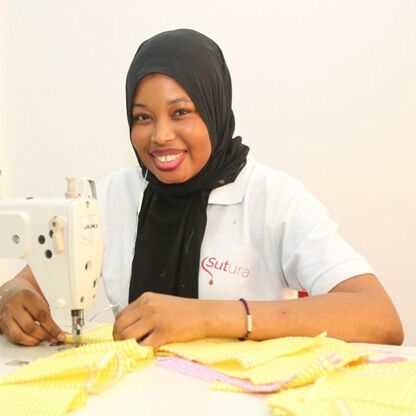
Sutura primarily recruits its employees from a sewing training school in Mali.
Photo credit: Alex Kouadjo
Sutura also does outreach to schools and conflict zones in the country, ensuring that essential information about menstruation and their product reaches those who need it most.
At schools they’ve installed sanitary pad dispersers and brought in healthcare professionals to educate girls. “It was important as a company to have this social impact where we raise awareness among the younger generation to train them in menstrual hygiene, how to calculate their menstrual cycle, avoid early pregnancies, talk about infections,” said Awa. “It’s a taboo subject and even more so in a patriarchal society like Mali.”
Within conflict zones they train people to set up their own businesses providing sanitary pads, since it can be difficult for Sutura to reach these markets. “We don’t see them as competitors, but rather as partners,” said Awa. Entrepreneurship has been noted as a powerful force for peacebuilding in West Africa.
Adam and Awa are also making an impact at a national level. They’ve pushed back against the ban on saying “period” on TV, and recently a national channel in Mali did a special report on the company. “It’s a challenge, but it’s a challenge that's beginning to lessen,” said Adam.
Sutura has also gotten involved with International Menstrual Hygiene Day, organized each year by the United Nations on May 28, to raise awareness of the lack of access to health education and period products for people around the world. Adam and Awa were able to bring together Mali’s ministers for entrepreneurship, the environment and the advancement of women to recognize this day, which was aired on TV in Mali.
This year Sutura is transitioning out of the funding from Zira Capital, so Adam and Awa are eager to find new funding sources to help them continue to make a positive impact with their business. These kinds of investments in impact-driven businesses are vital to achieve the UN Sustainable Development Goals (SDGs); there’s currently a $4 trillion USD gap in SDG funding, according to the UN Conference on Trade and Development.
Adam and Awa hope to advance their social impact goals to markets beyond Mali and have a larger reach across Africa, ultimately shifting the narrative around women’s health and improving the lives of millions.
Chain of impact investments from European Union Emergency Trust Fund to Sutura:
European Union Emergency Trust Fund: Pledged $5.4 billion USD to promote stability and address causes of migration and displacement in Africa.
I&P: Facilitated funding from the European Union Emergency Trust Fund to Zira Capital through the $16.6 million USD I&P Acceleration in Sahel (IPAS) program, dedicated to supporting small businesses and start-ups in the Sahel region.
Zira Capital: Provided funding to Sutura as the implementor of the IPAS acceleration program in Mali. Zira Capital has facilitated $638,808 USD in funding and technical assistance to small and medium enterprises in Mali.
Sutura: Raised $64,000 over two years from Zira Capital at a 0% interest rate.