When Gabrielle Xavier sees a need in her community she’ll find any way to bring in the resources to address it. She knocks on doors and fields phone calls and texts, connecting her neighbors with virtual telehealth services, financial counseling, tutoring sessions and more. Recently, when multiple members of a family she serves were struggling with health issues, Gabrielle found rental assistance to bridge the gap while they got back on their feet.
Gabrielle is the resident coordinator at the Green at 9 and 90, a multifamily housing development owned by the investment management firm Kayne Anderson, with just over 1,000 units in Framingham, Massachusetts in the U.S. She’s a lifeline for her residents, connecting them with the resources they need to improve their quality of life. Gabrielle works for Veritas Impact Partners, a non-profit dedicated to revitalizing America’s middle class by partnering with buildings like the Green to bring on-site support to residents.
I wanted to serve with Veritas to be able to help residents more…being able to see the kids and adults have the stress finally relieved, that’s my why,
Gabrielle said.
Gabrielle and Veritas are part of a network of partners working to make life at the Green stable for its residents — an impact that ripples out to other stakeholders in the Framingham community. Residents can access financial health resources like microloans and a credit improvement program, as well as free health and education services.
The building is undergoing a sustainable retrofit intended to lower energy consumption, greenhouse gas emissions, and residents’ utility bills. These social and environmental programs are spearheaded by Kayne Anderson, a member of the Global Impact Investing Network, as part of a strategy to help residents, the environment and the success of their investment.
American households are increasingly struggling to afford basic expenses. 2022 saw a record 22.4 million households that are cost burdened, meaning they spent more than 30% of their income on rent and utilities. Over half of Americans would struggle to cover a $1,000 USD emergency — something as simple as a popped tire or unexpected medical expense could leave most people with debt or an inability to pay for other essentials.
The need for affordable housing options in the U.S. has been particularly acute in recent years. Apartment rents increased 24% from 2020 to 2023, and only 15.5% of homes sold in 2023 were affordable for a typical U.S. household. Despite this nationwide need for accessible housing, many developers have prioritized new luxury builds over apartment housing that’s attainable to the vast majority of Americans. From 2020 to 2023 89% of the multifamily housing added in the U.S. were for upper-middle- and high-income renters.
“We see an opportunity for incredible demand for this type of housing that is not necessarily government-subsidized,” said Amanda Nunnink, senior managing director for multifamily impact housing at Kayne Anderson. The company bolsters the success of its long-term housing investments by supporting residents’ resiliency and being responsible environmental stewards.
Growing financial freedom
Kayne Anderson’s first priority for its multifamily buildings is financial accessibility: keeping rents at rates that residents can afford. Currently, 96.7% of units at the Green are affordable for households making 80% of the area’s median income.
To support financial health, all residents have the option of enrolling in positive on-time rent payment reporting to credit bureaus and accessing microloans through Kayne Anderson’s partner Esusu.
“I always say that credit treats you as though you’re guilty until proven innocent,” said Samir Goel, co-founder of Esusu. His company partners with building owners like Kayne Anderson to report rent payments to credit bureaus each month and grow renters’ credit, just like a bank would for a homeowner paying a mortgage.
At the Green, 97% of residents have enrolled in Esusu’s rent credit reporting, which doesn’t report late or missed payments, meaning there’s no risk to renters. On average, these households have increased their credit score by 31 points, and 33 residents at the Green have established a credit score for the first time.
“We feel like this should be a requirement in multifamily housing,” said Nunnink. There are about 44 million renting households in the U.S., but less than 10% have their on-time rent payments reported to the credit bureaus. The largest monthly payments for these individuals or families is likely going unnoticed, she explained.
Esusu also provides rental assistance in the form of 0% interest microloans through a non-profit partner dedicated to preventing homelessness. In the past two years Esusu has deployed about $68,000 in rental relief to the Green, a win-win for residents and the building owners.
It’s not about this esoteric three-digit number,” said Samir, “it’s about what credit unlocks, which is that economic mobility and opportunity to fulfill your dream.
Kayne Anderson chose to work with Esusu because their services come at no cost to residents, something they say is essential for all of the partners they bring on site. “We’re really thoughtful about who we partner with, that they are not trying to charge residents for their service and then make money off them,” said Amanda.
Supporting health, education, the environment — and residents’ wallets
One of the most popular programs at the Green is telehealth appointments, which Gabrielle coordinates through Veritas. Many families who would otherwise turn to urgent care and face expensive bills for visits can now access a doctor virtually for prescription refills or unexpected health questions.
This past fall, Gabrielle also organized a vaccine clinic ahead of flu season, and a festival that featured food and activities for families. Each month a mobile library comes on site, and students of any age can access free tutoring sessions on a range of subjects at any time, with math, reading and English as a second language ranking most popular.
In addition to investing directly in residents, Kayne Anderson has undertaken a full sustainable retrofit of the buildings at the Green. They’re installing energy efficient appliances, putting solar panels on the roof, adding new heat pumps to replace dated HVAC systems and installing low-flow toilets.
With these upgrades, they plan to reduce the property’s carbon footprint by 51% and reduce energy consumption by 60%. This is the “ultimate recycling project” said Patrick Flaherty, director of student and multifamily housing at Kayne Anderson. “These buildings are 50 years old, but we’re putting solar panels on and taking the common areas completely off the grid. That’s unheard of.”
Globally, buildings and construction are responsible for 37% of emissions, making the sector the largest greenhouse gas emitter, according to the UN Environment Program. Kayne Anderson has a net zero target by 2040 for its entire multifamily strategy, and in the immediate future it is striving to achieve top quartile energy performance scores for all new buildings and existing stock, measured by the U.S. Department of Energy’s ENERGY STAR benchmark.
As these sustainable upgrades help Kayne Anderson’s investment and the environment, they’re also lowering costs for residents. When the retrofit at the Green is finished, they expect tenants will see a 40% reduction in utility bills.
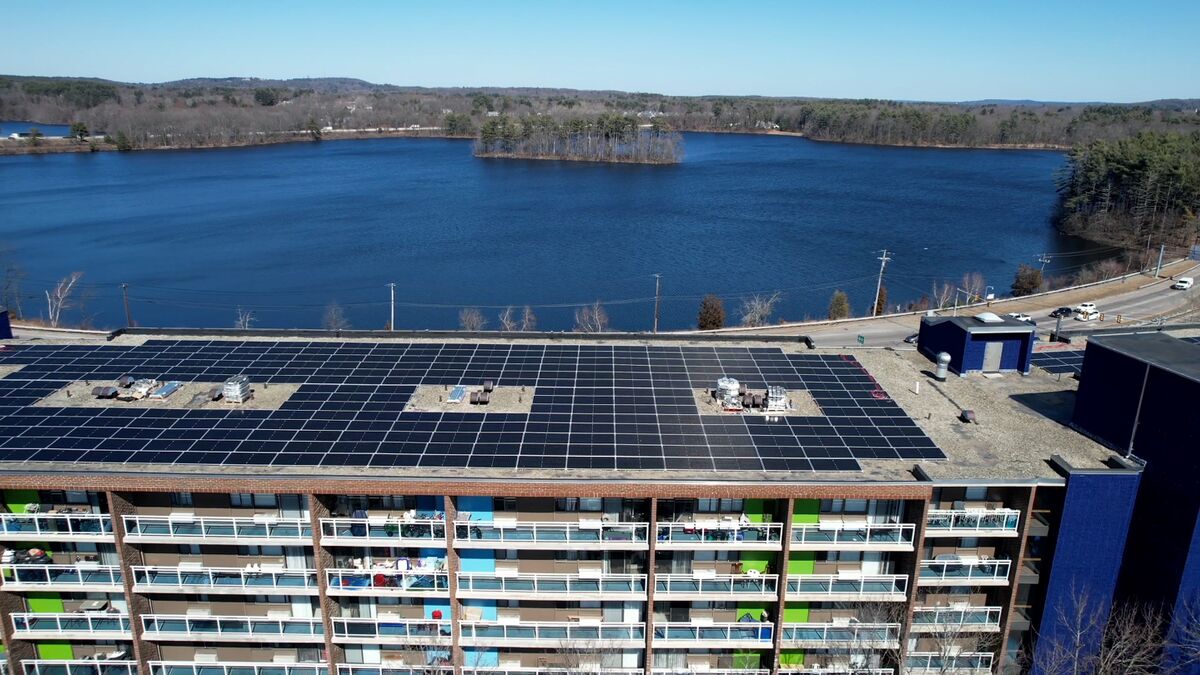
Solar panels on the roof of the Green at 9 and 90.
Residents that stay
Two years into this investment, the team at Kayne Anderson is encouraged to see that residents are responding to the programs offered. The key statistic they track is the 62% retention rate of residents — 16% higher than the national average of 52%.
“We can draw a correlation between our programs and the stickiness of our tenants,” said Nunnink. This is beneficial for residents who gain stability through consistent housing, and for Kayne Anderson, which experiences lower costs related to unit vacancy and turnover. Those lower costs provide Kayne Anderson a valuable return on its upfront investment in upgrades and resident services.
The team at Kayne Anderson and their partners all echo a similar sentiment: they want to see a world where families have the support they need for success and economic mobility. They see investing in attainable housing and the programs offered at the Green as addressing the root causes of poverty and the affordable housing crises in the U.S. Creating resilient residents and resilient buildings is at the heart of this project.
The Green offers a model for what’s possible at a larger scale: a world where developers can achieve strong risk-adjusted returns while helping families find security in their housing and finances, rather than taking away that stability.
We're hoping a lot of this becomes very commonplace over the next few years and the goalposts continue to move,” said Patrick. “That’s why we're constantly looking for innovations to bring to our properties.